Developing Speed for Middle-Distance Running
Improving maximum strength can steadily improve an athlete’s maximum speed, ease of race speed, and ability to finish strongly.
This must be varied throughout the year and culminate in light power development work. I believe in improving strength and power in the gym and leaving the endurance training for the track and circuit work done in sessions at the track. The only endurance work done at the gym is usually mid-torso training.
Low Hurdle Plyos
The aim is to develop quick contacts with the track. The hurdles must be kept low to ensure there are not long contacts.
Also, this should be done in very low volumes, e.g. 10 sets of 3 contacts with double-legged bouncing. (High-volume plyometrics is from the old Eastern Bloc drug cheating regimes)
Background Training
Base training usually involves plenty of hills and bounding uphill. This slowly builds up “strength endurance”.
Changing Pace Practise
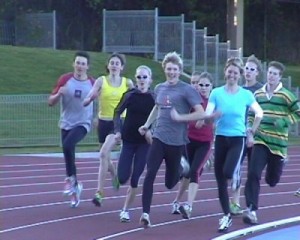
Changing pace must be practised and developed. Simulating race pace conditions is excellent fun for the athletes. Get the athletes to “bounce each other around” and take turns being the first person allowed to change the pace. This is great fun and excellent preparation for racing.
Practical Speed Work for 800m and 1500m Runners
Middle-distance athletes should include a maximum-speed session about once a week during base training, race preparation and the competition season. The details can change during the year, but regular exposure helps the athlete retain speed, coordination and relaxed running mechanics.
True maximum-speed work should be brief. Suitable examples include 30m sprints from a standing start or 20m sprints from a rolling start. Each repetition should emphasise speed with relaxation and good posture. In my experience, most injuries during 100% sprinting occur after 30m, so keeping these efforts short reduces unnecessary exposure once the athlete has reached maximum speed.
Race-specific sessions serve a different purpose. A typical 800m session is 10 × 200m at slightly faster than current 800m race pace, with three minutes recovery. For a 1500m athlete, 10 × 400m near current 1500m race pace with two minutes recovery is a useful benchmark.
Athletes and coaches will normally repeat these sessions during a season and record the results. Progress can then be judged against the athlete’s previous performances rather than against a generic target that may not suit their current development.
Junior athletes generally benefit from shorter repetitions and less total volume. As a rough guide, the fast running in a key session might total about twice the athlete’s race distance. Sessions should still vary throughout the year rather than repeating the same workout every week.
Middle-Distance Speed Training FAQs
How often should an 800m or 1500m athlete perform maximum-speed training?
About once a week throughout base training, race preparation and the competition season. The session can change with the training phase, but speed should remain part of the program all year.
What is a suitable maximum-speed session?
Use short efforts such as 30m sprints from a standing start or 20m sprints from a rolling start. Allow enough recovery to preserve speed, relaxation and good running mechanics.
Are 200m and 400m repetitions maximum-speed training?
No. They are race-specific speed sessions. An 800m athlete might run 10 × 200m slightly faster than 800m race pace with three minutes recovery. A 1500m athlete might run 10 × 400m near 1500m race pace with two minutes recovery.
How should coaches monitor progress?
Record the times and quality of familiar benchmark sessions. Because the athlete and coach repeat them during the season, they can compare current results with previous sessions and recognise genuine improvement.
When should a speed session be stopped or changed?
Stop immediately if the athlete is injured or feels an injury developing. The session should also stop or change if speed begins to fall, because slower repetitions no longer serve the intended purpose.
Should middle-distance runners use low-hurdle plyometrics?
Low-hurdle plyometrics are mainly useful for sprinters and should be performed in very small volumes. For middle- and long-distance runners, I prefer alternate-leg bounding from a standing start.